If you’ve ever been minding your own business and suddenly caught a flying elbow to the ribs, welcome to the club.

It’s not a club anyone wants to join, but here we are.
One minute you’re making toast. The next minute you’re questioning your life choices while a tiny human launches themselves across the room because you cut their sandwich into triangles instead of rectangles.
Many parents, especially parents of autistic or sensory children, end up asking the same heartbreaking question:
“Why does my child hit me?”
And the answer is usually a lot more complicated than “bad behaviour.”
In fact, some of the reasons might surprise you.
1. You’re the Safe Person
This is the one nobody tells parents.
Your child spends all day trying to hold it together.
At school they follow rules.
They sit when they’re told.
They cope with noise, lights, demands and social situations.
Then they come home.
And boom.
The pressure cooker explodes.
Unfortunately, you’re often standing nearest to it.
It doesn’t mean they hate you.
It usually means you’re the person they trust enough to fall apart around.
Not exactly a Mother’s Day card, but important to understand.
2. Their Brain Is Lagging Behind Reality
Imagine your internet buffering while everyone else is watching the film.
Some autistic and sensory children need extra processing time.
They hear the instruction.
They understand the instruction.
But their brain is still catching up.
If another demand arrives before they’ve finished processing the first one, frustration builds quickly.
What looks like an overreaction can sometimes be a brain that’s simply overloaded.
3. Hunger Doesn’t Look Like Hunger
With Isaac, one of the biggest triggers can be hunger.
Not because he’s politely saying:
“Mother, I require additional calories.”
More like:
“RAAAARRRRGH!”
Some children struggle to recognise hunger signals until they’re already overwhelmed.
By the time they realise they’re hungry, they’re not just hungry.
They’re furious.
4. They Don’t Know What They’re Feeling
Adults often assume children know why they’re upset.
Many don’t.
Especially sensory children.
They may feel uncomfortable, anxious, overwhelmed, excited, frustrated or scared without having the words to explain it.
Imagine having a fire alarm going off inside your body but not knowing where the fire is.
That’s what emotional dysregulation can feel like.
5. The Problem Started Hours Ago
This is another one many articles miss.
The thing that triggered the hitting might not be the thing that caused the hitting.
Maybe school was loud.
Maybe lunch felt different.
Maybe someone sat in their usual seat.
Maybe assembly was overwhelming.
Maybe PE was stressful.
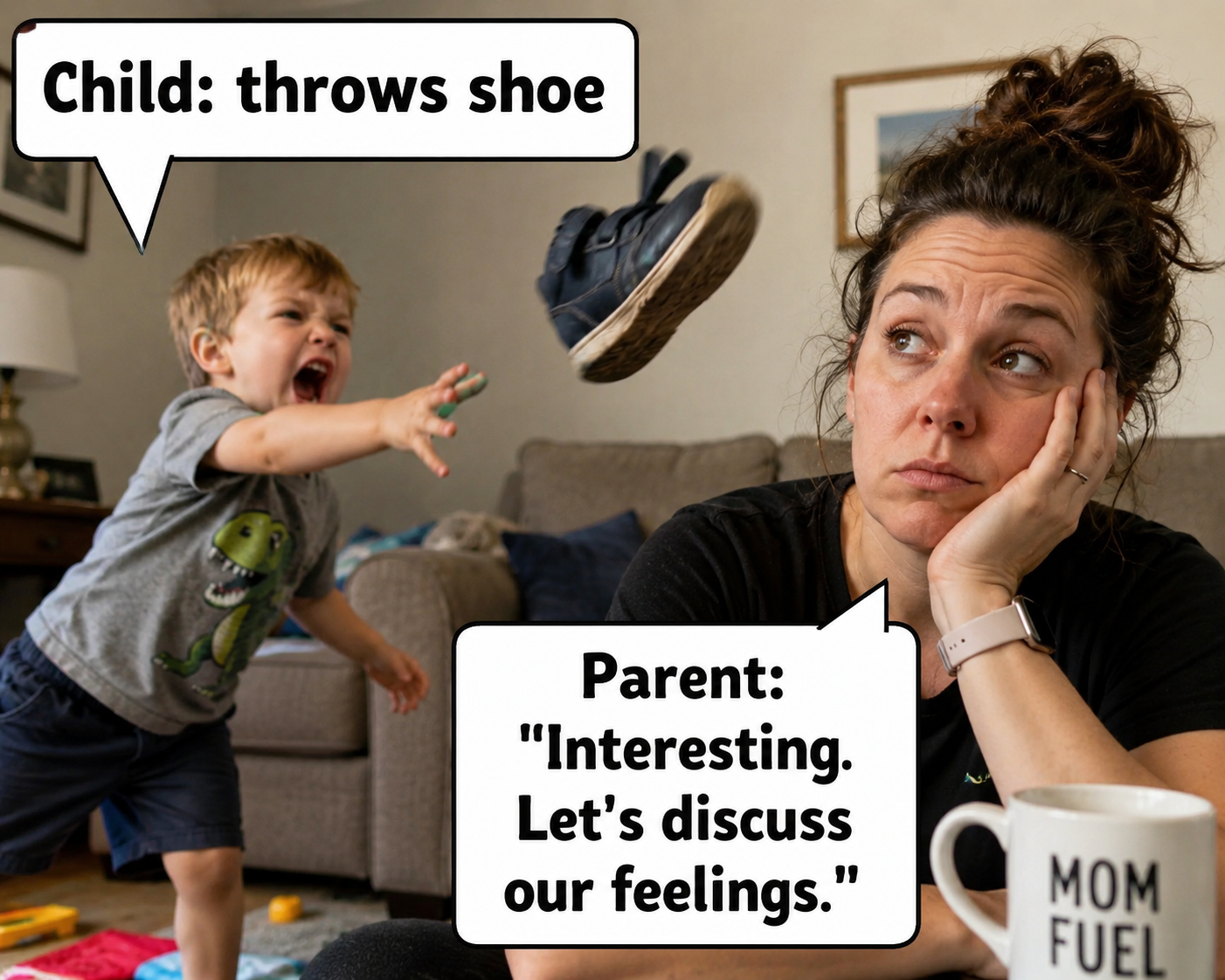
Then six hours later you ask them to put shoes on.
The shoes get blamed.
The shoes were innocent.
6. They’re Seeking Sensory Input
Some children hit because they’re angry.
Some children hit because they’re overwhelmed.
And some children hit because their nervous system is desperately searching for sensory feedback.
This can be especially confusing for parents.
To the child, the physical impact can provide intense sensory information that their brain is craving.
It’s not deliberate aggression.
It’s sensory seeking that has gone completely off-road.
7. They’re Borrowing Your Nervous System
This one sounds strange but stay with me.
Young children often regulate through the adults around them.
If your child is dysregulated, they may unconsciously look to your nervous system for safety.
When they can’t find that safety, panic increases.
This isn’t about being a perfect calm parent.
None of us are.
It’s simply understanding that children often co-regulate before they can self-regulate.
8. They Need Control Over Something
Many autistic children spend their day being told:
- Sit here
- Do this
- Stop that
- Come here
- Wait
- Hurry up
Eventually some children reach a point where they need control over something.
Anything.
When they can’t control the situation, they may try to control the people around them instead.
Again, not because they’re manipulative.
Because they’re overwhelmed.
What Should You Do When Your Child Hits?
First, keep everyone safe.
If possible, reduce demands, lower stimulation and give your child space to regulate.
Afterwards, become a detective instead of a judge.
Ask yourself:
- Were they hungry?
- Were they tired? Read Autism and Night Waking: Why Kids Don’t Sleep
- Was there a routine change? Read Routine Changes & Transitions
- Had they been masking all day? Read Masking at School
- Was something sensory bothering them? Read Does My Child Have SPD?
- Did the trigger actually happen hours earlier?
The goal isn’t to excuse hitting.
The goal is to understand it.
Because once you understand the reason, you can start preventing it.
Final Thoughts
If your child hits you, it doesn’t automatically mean you’re failing as a parent.
It doesn’t mean your child is bad.
And it definitely doesn’t mean you’re alone.
Sometimes hitting is communication.
Sometimes it’s sensory overload.
Sometimes it’s exhaustion, hunger, anxiety or a nervous system that simply can’t cope anymore.
The behaviour matters.
But the reason behind the behaviour matters even more.
And that’s usually where the real answers are hiding.
You might also like:
~ Why Does My Child Melt Down Over Small Things?
~ Does My Child Have Sensory Processing Disorder?
~ How To Calm A Sensory Meltdown Without Making It Worse